Bearings are the quiet workhorses of modern industry. From small electric motors driving factory conveyor belts to massive gearboxes operating inside mining mills, these compact mechanical parts carry heavy dynamic loads and enable smooth, frictionless rotational movement. When a single bearing runs efficiently, entire production lines operate seamlessly without interruption. However, when a bearing suffers unexpected wear, the consequences ripple across the entire facility: unexpected production stoppages, expensive repair bills, damaged drive shafts, and lost delivery schedules.
Many plant operators assume that achieving peak machinery reliability simply requires buying expensive equipment. In reality, discovering how to improve bearing performance depends on everyday operational habits, careful handling, correct lubricant choices, and clean working conditions. By understanding how rolling elements interact with their raceways and removing the common causes of premature wear, plant managers and maintenance technicians can dramatically extend machine life and prevent costly plant interruptions. For industrial facilities seeking predictable operational runtimes and verified component durability, partnering with experienced component specialists such as Alma Bearings (Almabearings) provides access to genuine, high-grade parts and technical guidance necessary to optimize overall bearing performance across demanding applications.
Click to purchase ball bearings.
1. Understanding Bearing Lifecycles and Common Failure Causes
To keep rotating machinery running smoothly, maintenance teams must first understand why bearings degrade before completing their expected service hours.
Identifying Preventable Everyday Breakdowns
Every rolling element bearing is designed to withstand millions of continuous rotational revolutions under specific mechanical conditions. During factory testing under laboratory settings, bearings eventually reach the end of their operational life through natural metal fatigue, where repeated contact stresses cause tiny surface flakes to separate from the steel raceways.
In actual factory environments, fewer than ten percent of industrial bearings ever reach this theoretical fatigue limit. The vast majority stop working far too early due to preventable external problems. Everyday issues such as dirty grease, excessive heat, physical impacts during mounting, loose housing fits, and severe machine vibration break down components prematurely. Recognizing that early machine breakdowns stem from preventable maintenance shortcomings rather than inherent component weaknesses is the foundational step toward sustained machine uptime.
Primary Forms of Physical Wear
When a damaged component is removed from an industrial housing, the mechanical wear patterns along its raceways reveal exactly what went wrong during operation:
- Abrasive wear occurs when airborne dust, sand, or hard manufacturing debris enters the bearing cavity and acts like sandpaper between moving metal surfaces.
- Adhesive wear or scuffing happens when lubricant films thin out under rapid speed or heavy pressure, causing bare metal surfaces to drag directly against each other and transfer material.
- Moisture corrosion forms rust pockets along raceways when water washes past seals, rapidly degrading high-strength carbon steel.
- Electrical fluting appears as tiny parallel washboard grooves across raceways when stray electrical currents from inverter-driven motors discharge through rolling elements toward the machine ground.
- Impact damage or brinelling creates permanent dents along the raceway surface when technicians hammer components onto shafts or expose machines to severe shock loads while stopped.

2. Choosing the Right Component for the Application
Achieving superior equipment reliability begins during component selection. Installing a part that does not match the actual physical operating environment guarantees premature failure regardless of how carefully maintenance teams lubricate the machine later on.
Matching Rolling Designs to Load Directions
Different mechanical assemblies subject shafts to distinct force vectors. Selecting the correct internal geometry prevents excessive localized stresses:
- Deep groove ball bearings are popular across small electric motors, domestic appliances, and light conveyor rollers because they support moderate radial weights at high rotational speeds with minimal running friction.
- Cylindrical roller bearings feature line contact instead of point contact, allowing them to carry heavy pure radial loads and severe shock forces in heavy machinery gearboxes.
- Spherical roller bearings contain two rows of barrel-shaped rollers running inside a curved outer ring, enabling them to handle massive radial weights while automatically compensating for bent shafts or housing misalignments.
- Tapered roller bearings are designed specifically to carry substantial combined forces, supporting heavy radial and axial pushes simultaneously across wheel hubs, heavy industrial transmissions, and reduction gear sets.
Accounting for Operating Temperatures and Clearances
As rotating shafts run continuously under load, mechanical friction and surrounding process heat cause the steel inner ring to warm up and expand outward. If a standard bearing without adequate internal room is fitted onto a warm operating shaft, this thermal expansion squeezes the internal space down to zero. The rolling elements become pinched tightly between the rings, creating extreme internal friction, rapid heat buildup, and sudden mechanical seizure.
In high-heat industrial environments such as drying ovens, boiler feed pumps, and rubber extruders, maintenance planners must specify bearings with increased internal clearance ratings, commonly designated as C3 or C4 tolerances. This additional internal clearance leaves sufficient room for natural thermal growth during hot production cycles, preventing destructive internal preloading and keeping temperatures within safe operational boundaries.
Selecting the Right Retainer Materials
The internal cage or retainer keeps rolling elements evenly spaced so they do not bump against one another during rotation. Choosing the appropriate cage material is critical for demanding operating conditions:
- Pressed steel cages represent the versatile standard for ordinary industrial motors and light belt pulleys.
- Machined brass cages offer superior structural strength, vibration resistance, and heat tolerance, making them essential for vibrating screens, heavy shaker tables, and reciprocating compressors.
- Engineered polymer cages deliver quiet running, low weight, and reduced friction in high-speed spindles, though they remain vulnerable to degradation when operating temperatures exceed normal factory thresholds.
3. Precision Installation and Mechanical Alignment Procedures
The way a machine is assembled directly establishes its baseline vibration, running noise, and operating temperature. Industry records demonstrate that roughly one out of every six premature bearing failures traces directly back to poor assembly practices and uncalibrated mounting methods.
Eliminating Hammer Impacts with Controlled Heating
One of the most destructive habits observed on factory maintenance floors is the use of heavy hammers, steel pipes, or open torches to force tight-fitting bearings onto machine shafts. Striking a bearing ring forces violent shock waves through the rolling elements, creating permanent micro-dents on the mirror-polished raceways. These tiny indentations disrupt smooth rolling motion immediately upon startup, causing loud running rumblings that rapidly deteriorate into extensive metal spalling.
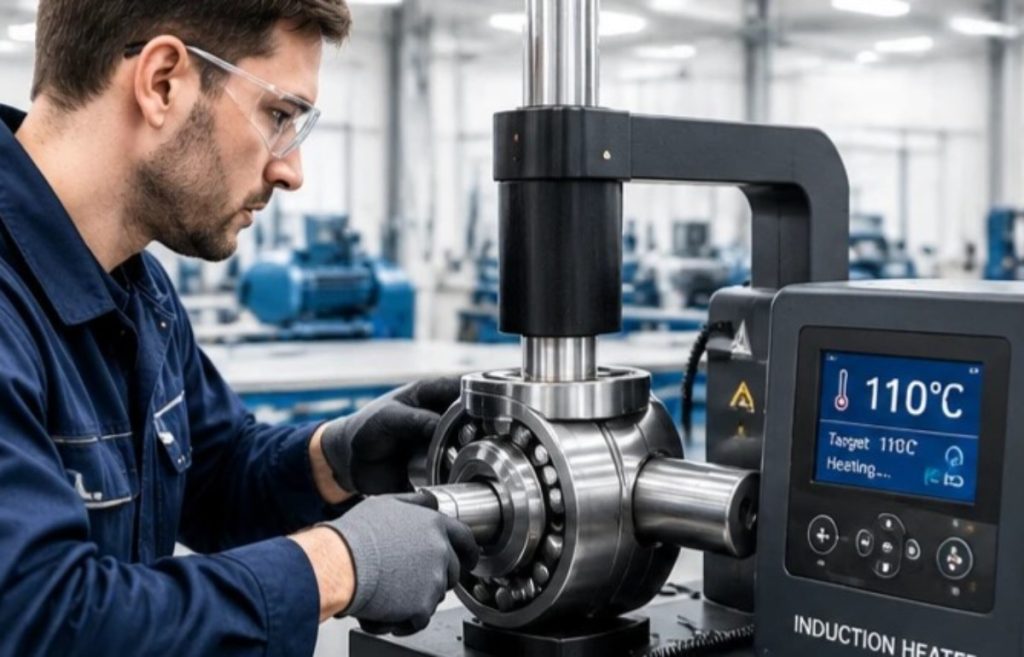
To install press-fit bearings safely, maintenance shops should always utilize temperature-controlled induction heaters. These electrical devices warm the inner ring evenly and cleanly, expanding the bore just enough so the bearing slides effortlessly into place along the shaft journal without mechanical force. Technicians should monitor the heating process carefully, maintaining temperatures around 110 degrees Celsius and never exceeding 120 degrees Celsius, which would permanently soften the hardened bearing steel and destroy internal pre-lubrication.
Verifying Shaft and Housing Dimensions
Even a brand-new, premium-grade bearing will fail rapidly if it is forced onto a deformed shaft or squeezed inside an out-of-round housing bore. Before sliding a warm bearing onto any machine journal, technicians should inspect the seat with calibrated micrometers:
- Measuring shaft diameters across several points confirms that the journal is perfectly round and free of taper or grooving.
- Checking housing bore fits ensures the outer ring will not slip or spin loose under load, which causes fretting corrosion and abrasive iron powder inside the housing.
- Inspecting shaft shoulders guarantees that the bearing seats flush against a flat, perpendicular backing surface, preventing tilted raceways that force rolling elements to track unevenly across raceway edges.
Eliminating Misalignment and Uneven Footing
When an electric motor connects to a pump or industrial gearbox, both shafts must align along a shared rotational centerline. Even modest angular or parallel misalignment forces rotating shafts to flex slightly on every turn, driving heavy bending stresses directly into the bearing rows.
Modern maintenance departments rely on optical laser alignment systems to position connected machinery shafts within tight tolerances. In addition, technicians must inspect machinery foundations for soft-foot conditions, where one base foot fails to make solid contact with the steel mounting plate. Tightening anchor bolts over an unsupported foot warps the machine frame, distorting the bearing housing bore into an oval shape that pinches internal clearances and elevates running temperatures. Using precision stainless steel shims underneath machine feet eliminates frame distortion and protects rotating parts.

4. Lubrication Management and Contamination Defense
Lubrication is the lifeblood of rotating machinery. More than forty percent of all premature bearing breakdowns occur due to lubrication mistakes: applying the wrong lubricant type, mixing incompatible greases, running dry, overfilling housing cavities, or allowing dirt to enter the grease.
Understanding the Fluid Separation Film
Inside an operating bearing, rolling elements do not actually grind directly against the steel raceways. Under proper operating conditions, a microscopic layer of oil is drawn into the contact zone, building a slippery physical barrier that lifts the rolling elements slightly away from the raceway surface. This fluid cushion prevents direct metal-on-metal friction, carries away operational heat, and prevents surface scuffing.
Selecting the right lubricant viscosity is critical to sustaining this protective fluid film. If the base oil inside the grease is too thin for the machine operating temperature and load, the fluid film collapses, allowing microscopic metal peaks to grind together and scrape off fine metal flakes. Conversely, if the lubricant is excessively thick, rolling elements struggle to push through the heavy fluid, creating parasitic fluid drag that drives up machine operating temperatures and wastes electrical power.
Avoiding the Costly Mistake of Over-Greasing
A widespread misconception among maintenance workers is that adding more grease always delivers better protection. In reality, over-greasing causes just as many mechanical failures as complete oil starvation.
When a technician pumps excessive grease into a standard bearing cavity, the rolling elements have no empty room to push excess grease aside. As the machine spins at full operational speed, the balls or rollers are forced to continuously churn through the dense grease mass. This continuous churning action generates intense internal friction, causing operating temperatures to spike rapidly. High operational heat bakes the grease thickener, boils off the lubricating base oil, and leaves behind a hard, crusty soap residue that can no longer lubricate moving metal.
For standard medium-speed machinery, bearing cavities should generally be filled to only thirty to fifty percent of their empty internal volume, leaving adequate open space for grease movement and air circulation.
Establishing Disciplined Relubrication Schedules
Grease does not last indefinitely. Over months of steady operation, mechanical shearing, ambient heat, and environmental exposure gradually degrade grease performance. Maintenance programs must replace guesswork with structured relubrication routines:
- Calculate exact grease replenishment amounts based on bearing diameter and width rather than pumping grease guns until seals burst open.
- Determine relubrication time intervals based on actual running speeds, operating temperatures, and environmental dust levels.
- Wipe grease fittings, gun nozzles, and storage containers thoroughly with clean rags before applying lubricant to keep dirt out of grease ports.
- Never mix different grease types without verifying chemical compatibility; blending incompatible thickeners causes grease to liquefy and drain completely out of bearing housings.
Defending Against Dust, Grit, and Moisture
Microscopic dirt particles and water droplets are sworn enemies of industrial bearings. Hard airborne mineral dust entering a bearing acts as an abrasive cutting compound, scratching smooth raceways and dulling rolling elements. Meanwhile, tiny moisture levels inside lubricating grease promote rust pits, degrade protective chemical additives, and induce hydrogen embrittlement that causes bearing steel to crack prematurely.
Protecting bearing performance requires robust external sealing defenses:
- Contact rubber lip seals keep clean lubricant enclosed while blocking coarse external dirt along standard factory shafts.
- Non-contact labyrinth isolators provide superior protection across harsh, dusty conveyor heads and outdoor processing plants without wearing down rotating shafts.
- Desiccant breathers mounted on oil sumps and gearboxes dry out incoming airflow, preventing humid ambient air from condensing into water inside bearing reservoirs.
5. Condition Monitoring and Predictive Maintenance
Rather than waiting for a bearing to fail and stop a busy production line, forward-looking industrial facilities use modern condition monitoring tools to detect early signs of internal wear weeks or months before a breakdown occurs.
Detecting Early Flaws with Vibration Monitoring
Every bearing design possesses unique, mathematically predictable vibration frequencies based on its internal dimensions, number of rolling elements, and rotational speed. When a microscopic scratch or spall begins forming on a raceway, each passing rolling element produces a tiny repetitive clicking sound.
Specialized vibration sensors mounted on bearing housings capture these high-frequency impact signals long before any damage becomes visible to the human eye or audible to the human ear. By tracking vibration trends over time, maintenance specialists can pinpoint whether a developing flaw is situated on the outer ring, inner ring, or rolling elements, allowing the team to order replacement parts and schedule maintenance shutdowns without disrupting production.
Using Thermal Scans and Lubricant Analysis
- Infrared thermography allows technicians to scan entire banks of operating machinery safely from a distance, identifying abnormal localized hot spots caused by lack of grease, over-tightened adapter sleeves, or severe coupling misalignment.
- Routine lubricant sampling involves sending oil samples to testing laboratories to measure microscopic metal wear particles, water contamination percentages, and remaining chemical additives. Finding tiny bronze slivers warns of cage wear, while elevated iron counts reveal active raceway abrasion, allowing maintenance teams to take corrective action before machines suffer catastrophic failure.

6. Sourcing Authentic, High-Grade Industrial Bearings
All the precision mounting tools, calculated lubrication routines, and advanced vibration sensors in the world cannot compensate for an inferior, poorly manufactured component. The global market contains numerous counterfeit and substandard bearings that look convincing on the outside but are made with low-grade steel alloys, inconsistent heat hardening, and irregular raceway finishes. When installed in demanding industrial applications, these substandard parts deform under heavy loads, wear down rapidly, and can fail catastrophically within hours of startup.
To safeguard valuable production machinery, purchasing departments must ensure that every replacement part comes through dependable, authorized distribution networks. Leading industrial facilities rely on established component suppliers such as Alma Bearings (Almabearings) to source authentic, rigorously manufactured bearings and power transmission accessories. Working with trusted distribution partners ensures that replacement components deliver uniform metallurgy, precise dimensional tolerances, and predictable service lifespans across demanding factory environments.
7. A Step-by-Step Maintenance Routine to Maximize Lifespan
Consolidating these engineering principles into daily plant routines requires establishing clear, standardized maintenance procedures across the entire facility:
- Inspect Every Failed Component: Never toss a worn bearing into the scrap bin without opening it up to inspect raceway wear tracks, grease appearance, and seal condition to discover the true root cause of failure.
- Keep New Bearings Sealed: Leave replacement bearings in their protective factory wrapping until the exact moment of installation, protecting precision-ground surfaces from airborne shop dust.
- Use Calibrated Assembly Tools: Ban open heating torches and hammer impacts; equip maintenance bays with induction heaters, hydraulic mounting nuts, and laser alignment tools.
- Measure Shaft and Housing Fits: Verify that journal diameters and housing bores match correct engineering tolerances before sliding replacement parts into position.
- Standardize Lubrication Practices: Calculate exact grease quantities, label grease guns to avoid mixing incompatible thickeners, and clean all grease fittings before pumping lubricant.
- Upgrade Housing Sealing: Install heavy-duty contact seals, labyrinth isolators, and desiccant breathers on equipment operating in wet, steamy, or dusty environments.
- Monitor Operating Health Continuously: Track vibration levels and operating temperatures periodically to catch developing mechanical flaws early and schedule planned replacements.
Conclusion
Maximizing equipment availability and minimizing operational costs in industrial plants requires continuous attention to rotating machinery health. As detailed throughout this guide, learning how to improve bearing performance is not an isolated task but a comprehensive operational philosophy that spans proper part selection, clean handling, temperature-controlled assembly, disciplined lubrication, and routine condition monitoring. When maintenance teams eliminate hammer impacts, prevent over-greasing, keep dust and water out of bearing housings, and source certified parts from trusted suppliers, machines run quieter, consume less electrical power, and deliver years of dependable service. For industrial organizations seeking to upgrade plant reliability, reduce downtime, and source authenticated high-durability components, collaborating with specialized industry suppliers like Alma Bearings (Almabearings) provides the technical backing and dependable supply chain needed to keep rotating assets running at peak efficiency.
Click to purchase roller bearings.
Frequently Asked Questions
1. What is the most common reason industrial bearings fail prematurely?
The single most common cause of premature bearing failure is improper lubrication, which accounts for more than forty percent of all early breakdowns. This includes using the wrong oil viscosity for the operating temperature, pumping excessive grease into the housing cavity, allowing dirt or moisture to contaminate the grease, or failing to replenish lubricant at proper intervals.
2. Why is over-greasing just as harmful as running a bearing dry?
When a bearing cavity is overfilled with grease, the rolling elements have no room to push excess lubricant aside. As the shaft spins, the balls or rollers are forced to churn through the dense grease mass, creating intense hydrodynamic friction. This friction causes operating temperatures to spike, which rapidly cooks the grease, separates the oil from its thickener, and destroys the bearing through heat-induced seizure.
3. How does shaft misalignment shorten bearing service life?
When connected machine shafts are misaligned, rotating components do not share a common rotational centerline. This angular or parallel offset forces the shaft to bend slightly on every turn, driving heavy uneven loads into the bearing raceways. This uneven edge loading concentrates immense stress along narrow strips of steel, leading to rapid metal fatigue, noisy operation, elevated running temperatures, and early surface flaking.
4. Can a damaged bearing be repaired and put back into service?
Large, expensive bearings used in heavy industries such as steel rolling mills, paper processing plants, and mining crushers can often be professionally remanufactured by specialized facilities if they are removed before severe catastrophic damage occurs. However, smaller standard ball and roller bearings used in everyday electric motors and pumps are not cost-effective to repair and should be replaced with new, authentic components.
5. What are the earliest warning signs that a bearing is beginning to degrade?
The earliest warning sign of internal bearing degradation is a change in high-frequency vibration signals, which can be detected by vibration monitoring sensors weeks before any visible damage appears. As the defect worsens, the bearing begins running noticeably hotter than normal, emits audible rumbling, humming, or screeching noises, and eventually exhibits visible shaft play or wobble during operation.